Phone: (808) 585-3300 Fax: (808) 545-5063
Roman Catholic Church in the state of hawaii
Diocese of Honolulu
E Hiki Mai Kou Aupuni
News & Events
Help me find...
- Home
- >
- News & Events
- >
- News Articles
- >
- 2026
- >
- November
- >
- 11/17 Aloha in ʻOhana
- >
News Articles
Aloha in ʻOhana: Giving Thanks, Sharing Love, Building the Kingdom
November 17, 2026
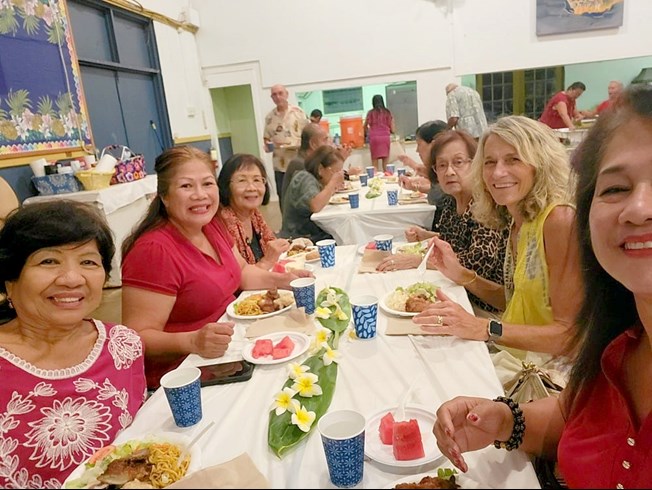 (Photo courtesy of St. Michael Church, Waialua)
From the Office for Social Ministry
“The Eucharist, which is the sacrament of unity, nurtures our belonging to the Body of Christ and teaches us how to share…it impels us to be an active part of a community, to share the gifts we have received freely, and to offer what little we have for the good of many.” Pope Leo XIV Homily in Argentina, November 11, 2026
Eucharist is a Greek word for “giving thanks.” Thanksgiving is a time when we gather with family and friends to share a meal and give thanks. Therefore, it’s a good time to ask what the sacrament of Eucharist means in our everyday lives. In his November 11 homily at Our Lady of Luján in Argentina, Pope Leo XIV provided some profound reflections on how the Eucharist nourishes our belonging to the Body of Christ and calls us to give thanks through sharing empathy and building the kingdom together, by becoming what we receive: Christ's living presence in the world.
Pope Leo points out the Eucharist connects giving thanks, communion and mission, something reflected in a familiar question during the holidays. Who has a place at our thanksgiving tables, at our Eucharists? Pope Leo reminds us, “There is a place for everyone, especially for those who are most in need: the poor and the hungry, migrants, the sick and prisoners, with whom the Lord identifies.”
Speaking to new bishops in Rome about the recent encyclical Magnifica Humanitas, Cardinal Michael Czerny SJ, reflected on how Pope Leo says the Eucharist helps us see others with more compassion and build the kingdom of God together. “Charity, nourished by the Eucharist, shapes the act of building together. The broken bread creates a people in which each person receives the life of Christ and learns to bear the burden of the other.” Here in Hawaiʻi, one way we live aloha is as one ʻohana, making room for people beyond our own biological families and circles of friends. Aloha in ʻOhana is an expression of how we are all one human family. It reminds us that we belong to one another through love and shared responsibility for our common home.
Our new Bishop Michael T.T. Castori SJ brought this message home in his November 6 homily reflecting on the inseparable commandments to love God and love our neighbor. He explained that the key to understanding this relationship is empathy, which means entering so deeply into another person's suffering that it becomes our own. Bishop Castori recalled how God asked the Israelites to remember that they too had once been strangers, “aliens” in Egypt. Empathy means recognizing our shared humanity and remembering that, under different circumstances, we ourselves might be seeking refuge, safety, or a helping hand. Bishop Michael reminds us: “When we identify with the feelings of someone who is poor or deprived — when we make his or her hardship our own — we share in what God actually feels for him or her.”
Our beloved missionary Saints Damien of Molokaʻi and Marianne Cope understood this truth. They did not merely help from a comfortable distance. They entered the suffering of those affected by Hansen's disease, sharing their lives, recognizing their dignity, and together building communities of belonging. As Bishop Castori said “how fitting that these saints lived, loved and died in the very land of aloha whose notion of ‘ohana extends beyond blood relationship so as to value the entire community in its inter-connectedness, reverencing the responsibility that each of us has for the other. “
Their witness challenges us to be missionaries of love today by compassionately accompanying families recovering from storms, supporting parish food ministries, welcoming migrants and refugees, visiting isolated kūpuna, and listening to those experiencing hardship and suffering. These are not extraordinary acts reserved for saints. They are ordinary expressions of empathic Eucharistic love available for every one of us to be each day.
Pope Leo reminds us to offer whatever little we have for the good of many. A shared meal, a listening ear, a generous donation, a welcoming parish community, or an hour of volunteer service can become an instrument of God's amazing grace. Cardinal Czerny reminds us that faithful hope sustains this eucharistic ministry, even when results are slow or invisible. Some seeds of compassion planted today may bear fruit only years later. That is particularly encouraging for our parishes and charitable ministries, where the needs sometimes seem overwhelming and resources limited. Bishop Castori reminds us, “in building this kingdom of God, let us shine this light of divine empathy in our midst and on the world, walking in the steps of Sts. Damien and Marianne, becoming like Christ himself, “like unto” the love of God and love of neighbor. “
This holiday season, as we give thanks for the people who have made room for us, let us think of someone who could use a place at our table or a little of our time. May our Eucharistic celebrations deepen our empathy, strengthen our aloha as ʻohana, and nourish us to build the Kingdom of God in Hawaiʻi where no one is forgotten and everyone feels they belong.
For more on Pope Leo XIV’s Magnifica Humanitas and Cardenal Michael Czerny’s reflections, please visit the Vatican website www.humandevelopment.va. Mahalo, and Happy Thanksgiving!
