Phone: (808) 585-3300 Fax: (808) 545-5063

Roman Catholic Church in the state of hawaii
Diocese of Honolulu
E Hiki Mai Kou Aupuni
News & Events

Help me find...
- Home
- >
- News & Events
- >
- News Articles
- >
- 2026
- >
- May
- >
- 5/4 Living “Holy Restlessness” in Hawaii
- >
News Articles
Living “Holy Restlessness” in Hawaiʻi
May 4, 2026
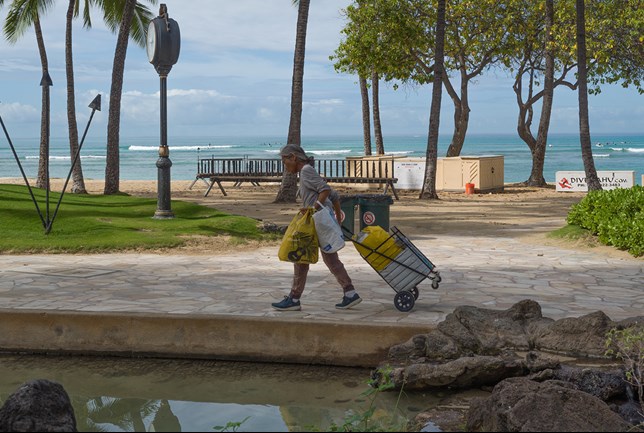 (Theodore Trimmer / Shutterstock.com)
From the Office for Social Ministry
“To form consciences that are free and endowed with a holy restlessness is a necessary condition for the Christian faith to appear as a fully human proposal.” Such a faith is capable of transforming the lives of individuals and of society, of inspiring prophetic change in the face of the tragedies and forms of poverty of our time, and of encouraging a continual search for God that is never satisfied." - Pope Leo XIV, Address to the Catholic University of Central Africa, April 2026
During his recent trip to Africa, Pope Leo XIV reflected on the importance of forming consciences marked by what he calls a “holy restlessness.” Speaking to university students, he reminded them that education is not only about knowledge or professional success, but about forming people prepared to serve the common good.
A “holy restlessness” is not anxiety or dissatisfaction for its own sake. It is that quiet stirring within the heart that refuses to accept injustice, notices suffering, and keeps asking: What more can I do? Where is God calling me now? It is the voice of conscience—the “inner sanctuary,” as Pope Leo describes it—where we encounter God and are drawn toward truth, goodness, and love.
“The greatness of a nation cannot be measured solely by the abundance of its natural resources, nor even by the material wealth of its institutions. No society, in fact, can flourish unless it is grounded in upright consciences, formed in the truth.”
In a world that often measures greatness by wealth, power, or influence, Pope Leo invites us to see differently. A country, a community, even a parish or family flourishes not because of what it possesses, but because of who its people are—men and women whose consciences are formed in truth and guided by charity.
This vision echoes the Church’s enduring teaching on love of God and love of neighbor. As Augustine of Hippo reminds us, love of neighbor is not genuine unless rooted in love of God—and love of God is incomplete unless it embraces our neighbor. This twofold love becomes the compass of a well-formed conscience.
So how do we live this out in a world marked by so many needs?
Recent synodal reflections on “Listening to the Cry of the Poor and the Earth” offer a practical and deeply spiritual answer: we begin by listening.
Listening, in the Christian sense, is not passive. It means encountering others where they are, hearing their stories, seeing their reality, and allowing ourselves to be moved. The “cry” is not just a metaphor—it is the real suffering of people facing poverty, displacement, loneliness, or exclusion. It is also the cry of the earth itself, wounded by neglect and exploitation.
And these cries are not separate. When the environment is degraded, it is often the most vulnerable who suffer first and most deeply. To listen well is to recognize these connections and respond with compassion and wisdom.
Many in our parishes are already living this call in quiet but powerful ways—through outreach ministries, accompaniment, and care for creation. Here in Hawaiʻi, we often speak of mālama the ʻāina, caring for the land that is our shared home as one human ʻohana. These efforts matter. They are signs that the Gospel is alive among us.
But true listening leads beyond occasional acts of charity to deeper relationships marked by trust and mutual respect. It also leads to action—sometimes immediate, as in providing food or shelter; other times requiring reflection, collaboration, and long-term commitment to justice and peace. As Christ reminds us, “I have come that they may have life, and have it to the full” (John 10:10).
Importantly, Pope Leo and Pope Francis remind us that those who suffer are not simply recipients of care. They are partners in shaping a more just and compassionate world. When we listen deeply, we discover not only needs, but also wisdom, resilience, and hope.
This kind of listening also calls us into wider collaboration—across communities, cultures, and even faith traditions—recognizing that the challenges we face are often larger than any one group can address alone.
Yet none of this can be sustained without prayer. Listening to the cry of the poor and the earth begins with listening to God. In prayer, our consciences are formed and our actions guided by grace.
In the end, the question is both simple and profound: What does love require of us here and now?
If we allow that question to shape us—if we cultivate that “holy restlessness” within—our faith can become a living force capable of transforming lives, communities, and even the world itself.
And together, step by step, we can participate in Christ’s mission where every person can experience the “full and abundant life.”
For more on the Popes’ recent teachings, please visit www.humandevelopment.va. Mahalo.
