Phone: (808) 585-3300 Fax: (808) 545-5063
Roman Catholic Church in the state of hawaii
Diocese of Honolulu
E Hiki Mai Kou Aupuni
News & Events
Help me find...
- Home
- >
- News & Events
- >
- News Articles
- >
- 2026
- >
- May
- >
- 5/20 E Hiki Mai Kou Aupuni
- >
News Articles
“E Hiki Mai Kou Aupuni – Thy Kingdom Come”
May 20, 2026
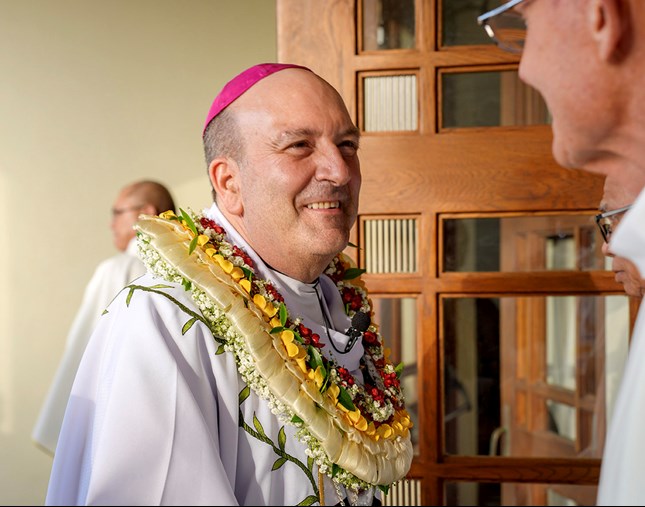 (Photo by Ryan Fielding)
From the Office for Social Ministry
“In God everyone is fully themselves.”
Pope Leo XIV’s Regina Caeli address May 3, 2026
“E hiki mai kou aupuni — Thy Kingdom Come.” For Catholics in Hawaiʻi, these familiar words from the Hawaiian Our Father have taken on renewed meaning with the appointment of Honolulu’s Bishop-elect Michael Castori. This holy phrase echoes the prayer of generations and the hopeful message recently shared by Pope Leo XIV in his recent Regina Caeli reflection.
In his May 3 public noon prayer, Pope Leo invited Christians to imagine the difference between what he called the “old world” and the “new world” opened by the Risen Christ. In the old world, value is often measured by status, privilege, influence, and recognition. Yet the Holy Father reminded the Church that the Kingdom of God reveals a radically different way of living. “In the new world into which the risen One leads us,” Pope Leo reflected, “what is most valuable is within everyone’s reach.” In the new world of God’s kingdom, “what is open to all now brings joy. Gratitude takes the place of competition; welcome overcomes exclusion; and abundance no longer entails inequality. Above all, no one is mistaken for someone else, and no one is lost.” No one is forgotten. No one is invisible. As Pope Leo beautifully reminds us: “In God everyone is fully themselves.”
This is what we pray for every time we say: “Thy Kingdom Come.” Not only a kingdom we hope to happen someday in heaven—in the here-after--but one being built in the here-and now, in the ways we love, welcome, forgive, and care for one another. A kingdom where dignity is not earned but recognized. Where every person knows they belong. These words resonate here in Hawaiʻi. Many families struggle beneath the rising costs of housing and food. Young people wonder whether they will ever be able to remain in the islands they call home. Migrants, refugees, the poor houseless, and the lonely often carry the painful burden of feeling unseen or forgotten. Even within communities and churches, some quietly wonder whether they are truly welcomed. Yet Pope Leo points us back to the heart of the Gospel: our worth does not come from prestige or possessions, but from being loved by God. The Pope reminds us “Have faith,” Jesus tells us. “Have faith in God; have faith also in me.” Faith frees the human heart from the exhausting illusion that we must constantly compete for dignity or recognition. Every human person already possesses infinite worth because each person is created and loved by God.
It is striking, then, that Honolulu’s new bishop has chosen as his episcopal motto the words: “E hiki mai kou aupuni” — “Thy Kingdom Come.” In his recent joyful and grateful reflections, Bishop-designate Michael Castori spoke candidly about feeling overwhelmed when first receiving the call from the Vatican. After days of prayer, he entrusted himself to God’s guidance with humility and trust. His life journey seems to embody Pope Leo’s words. Having ministered South Sea Islanders in Guam, Fiji, Tonga, and California, Bishop-elect Michael Castori has experienced what he calls “the wonder of a diverse community.” He has witnessed how cultures, languages, and traditions — rather than dividing people — can become signs of God’s creating a kingdom of one “ohana” when approached with humility and mutual respect.
The new bishop-elect also reflected gratefully on Polynesian spirituality, which deepened his understanding of Christ the King as ruling through sacrifice, humility, and love. A king who draws close to suffering people. A shepherd who walks with all his flock. This reminds us “Thy Kingdom Come” means building community where no one is excluded because of language, immigration status, economic hardship, race, or background. It means churches truly become homes open to all and attentive to every person. It means caring with our kūpuna, accompanying migrants and refugees, encouraging young people, strengthening families, ensuring the lonely are not forgotten. It means remembering that aloha is not only a greeting, but a way of living rooted in dignity, compassion, and mutual care.
Bishop-elect Michael Castori’s commitment to dialogue across cultures and faith traditions offers nourishing hope for our islands. In a world often marked by division, his experiences collaborating with Jewish, Muslim, Hindu, and Christian communities remind us that working together for justice and peace is where God’s love becomes visible. This is God’s call to us all.
Pope Leo reminds us that the kingdom becomes visible whenever ordinary people love one another as Christ has loved us — in parishes, schools, neighborhoods, ministries, and homes. Sometimes the kingdom arrives quietly: in welcoming someone sitting alone at Mass, helping struggling families, listening across cultural differences, serving with all vulnerable persons, showing all lives matter. These “extra-ordinary” acts become signs that another world is possible — not a world shaped by competition and exclusion, but one rooted in gratitude, hope, justice, peace. These are words that call us to live our faith building just and joyful communities. As Hawaiʻi prepares to welcome a new bishop, Pope Leo XIV’s message and Bishop-elect Michael Castori’s Hawaiian motto are providentially intertwined: “E hiki mai kou aupuni — Thy Kingdom Come.” A prayer. A mission. A reminder that the kingdom of God is coming whenever we help one another feel welcomed as members of one ohana, embraced in the heart of our Creator. Mahalo.
