Phone: (808) 585-3300 Fax: (808) 545-5063

Roman Catholic Church in the state of hawaii
Diocese of Honolulu
Witness to Jesus
News & Events

Help me find...
- Home
- >
- News & Events
- >
- News Articles
- >
- 2026
- >
- January
- >
- 1/26 A Beloved Community
- >
News Articles
A Beloved Community of Faith, Compassion, and Responsibility
January 26, 2026
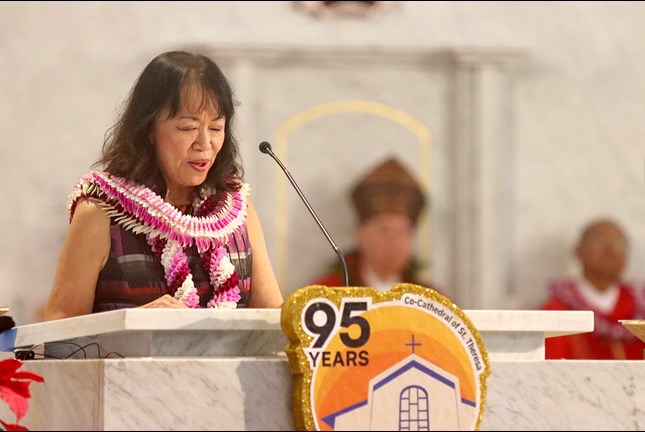 (Photo courtesy of Dann Ebina)
From the Office for Social Ministry
“And what does the Lord require of you? To do justice, to love mercy, and to walk humbly with your God.” (Micah 6:8)
One scripture passage that has powerfully shaped social ministry is the Old Testament prophet Micah’s message about what God requires of everyone: “do justice, love mercy, and walk humbly with God.” Micah 6:8 offers a fundamental framework for very heart of social ministry. This was compellingly expressed by Connie Mitchell, the Executive Director of the Institute of Human Services-IHS on Oahu, during her address at this year’s Diocesan Red Mass in St. Theresa’s Co-Cathedral on January 14. She is a Hawaiian born Anglican Christian who has been serving with persons suffering homelessness on Oahu for 40 years. Her lived experience provides an insight into social ministry community collaborations grounded in the Gospel.
Pope Leo XIV, in his recent pastoral letter Dilexi Te (“I have loved you”), wrote that Jesus “identified himself with the lowest ranks of society” and by pouring out his love “confirms the dignity of every human being, especially when they are weak, scorned, or suffering.” Ms. Mitchell echoed the teachings of Pope Leo when she asked, “What could bring us all together more than serving those who seemingly occupy the lowest ranks of society, just as Jesus did… confirming the dignity of every human being?” Service is not only living charity, it is unifying.
Her Red Mass reflections resonated all the more during the following national holiday weekend that commemorated the life’s legacy of Dr. Martin Luther King Jr., a Baptist minister who was awarded the Nobel Peace Prize at the age of 35, then assassinated at the age of 39 and whose vision of the Beloved Community continues to challenge and inspire peoples worldwide. Both Dr. King and Ms. Mitchell reminded us that justice is relational and inseparable from the work of building authentic community in our homes, neighborhoods, and country.
Those who serve with the marginalized poor know that their suffering results from a combination of realities. Ms. Mitchell pointed out that homelessness is the accumulation of skyrocketing rents, untreated mental illness, addiction, fractured families, and systems that fail to coordinate care. Behind every statistic is someone’s kupuna, sibling, or neighbor. She also reminded all at the Red Mass, including public officials, that addressing this reality requires “doing justice” — which means having the courage to re-examine policies, assumptions, and structures that no longer serve the common good. While accountability and oversight matter, so does honesty about where our systems fall short, especially when vulnerable people slip through the cracks between healthcare, legal, and social service frameworks. Dr. King understood this tension well, insisting that laws alone cannot create justice unless animated by a compassionate moral vision and human solidarity.
Micah’s prophetic message did not end with justice but calls all :to love mercy.” Mercy listens and responds with compassion that is rooted in relationships. Ms. Mitchell and Dr. King reminded us that Jesus models mercy by honoring the stories of those in need. Compassion requires seeing beyond behaviors to the wounds beneath them. Christ showed us that mercy accompanies patiently, as God’s healing grace transforms shared vulnerability into the strength of communion.
And last, but not least, Micah’s social ministry message calls all “to walk humbly with God” — a humility that acknowledges none of us can do this work alone. Building justice is not a solo effort, nor is it a project that can be completed in a single lifetime. Ms. Mitchell and Dr. King reflected that although we may not live to see the completion of our mission, we can trust that what we build together — policy by policy, relationship by relationship — will bless generations yet to come.
Dr. King famously said that “the ultimate measure of a person is not where they stand in moments of comfort, but where they stand in times of challenge.” Ms. Mitchell believes that some of today’s challenges are clear. Homelessness, poverty, and division are not only policy problems; they are crises of belonging. As she put it, “People often ask me what I think the solution to homelessness is… But I usually say ‘community’ is the answer… People — all of us — need to feel that we belong somewhere.”
Here in Hawaiʻi, we already see glimpses of that belonging. Ms. Mitchell cited parish ministries that collaborate with community service organizations, such as the Food Bank distributions at St. Theresa Co-Cathedral, IHS partnerships with St. Augustine homeless out in Waikīkī, and the community service fairs hosted by St. Ann in Kāneʻohe, where persons are not treated as clients, but as ʻohana. People are fed, listened to, prayed with, and welcomed into genuine community. In these places, the community collaboration becomes living the Gospel mandates of loving thy neighbor and lifting up the dignity of every human person. For more info on community collaborations with the Institute for Human Services-IHS, please visit their website www.ihshawaii.org.
As we continue forward in this New Year, let us recommit to building the Beloved Community — one rooted in faith, compassion, and shared responsibility. A place where no one is invisible. A place where justice is pursued with courage, mercy is offered with wisdom, and humility keeps us open and responding to God’s ongoing call for all to do justice, love mercy, and walk humbly together with our Creator. Mahalo.
